

LOCSU urges use of optometry in frailty care following Public Accounts Committee report
9 June 2026
LOCSU is calling on eye care to be integral to the planning and prevention of frailty after a Public Accounts Committee (PAC) report found overloaded GPs could not adequately carry out the necessary assessments.
GPs are contractually obliged by NHS England to identify, assess and support people living with frailty. The report found many were unable to deliver the required care, with just 17% of patients aged 65 or over assessed for frailty in ’24-’25.
Of the 226k people diagnosed with severe frailty, only 16% were found to have had a medication review, whilst only 18% had been seen for a falls risk assessment.
Poor vision is a contributory factor in falls and frailty, and as the PAC report finds GPs’ unable to deal with such priorities due to capacity, LOCSU calls for eye care to be included as part of the solution.
Regular sight tests can help identify risks at an early stage, reducing falls and supporting independence whilst easing pressure in other areas of neighbourhood health.
Zoe Richmond, Clinical Director at LOCSU, said: “The statistics in this report are disappointing. They show too many older people are being missed out, or not receiving the follow-up support they require.
“Appropriate support must be put in place for general practice, and optometry should be recognised as part of the solution: timely eye care can help identify risks earlier, reduce falls, support independence and play a stronger role in preventing frailty and improving care for those already living with it.
“If we are serious about prevention, reducing falls and supporting older people to live independently for longer, eye health and optometry must be embedded in local frailty pathways, risk assessment and follow-up care. If primary care optometry is to take on additional work to support frailty management and fall prevention, NHS funding must follow so services are properly commissioned and sustainable”
Janice Foster, LOCSU CEO, said: “This report is a stark reminder that we cannot keep asking GPs to do more with less while overlooking one of the most accessible, clinically skilled primary care workforces we already have.
“The real issue isn’t just pressure – it’s untapped, unresourced potential. More than 6,000 optical practices sit in the heart of our communities, clinically skilled and ready to play a far bigger role, yet still too often missing from the conversation.
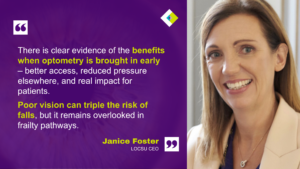
“There is clear evidence of the benefits when optometry is brought in early – better access, reduced pressure elsewhere, and real impact for patients. Poor vision can triple the risk of falls, but it remains overlooked in frailty pathways.
“Identifying vision issues and supporting access to the appropriate support is fundamental to independence. This isn’t theoretical; it’s proven.
“If health system leaders are serious about prevention, tackling inequalities and delivering care closer to home, we have to stop designing pathways in silos. Optometry is not an optional extra – it’s a critical part of the solution hiding in plain sight and must be included in the design from the start, or the opportunity will continue to be missed.”